Top of Mind — Is Your Brand Recalled Before Competitors?
The Top of Mind metric in BrandWise: whether ChatGPT and Claude recall your brand ahead of competitors. Formula, crowding penalty, competitive table, examples.
What Top of Mind Measures
Top of Mind (TOM) measures whether an AI model recalls your brand before competitors. The metric accounts for the order in which the brand first appears and the number of competitors mentioned — the earlier the brand and the less "noise" from competitors, the higher the score.
In marketing, Top of Mind is the first brand a consumer thinks of in a category. In the AI context, it's the first brand the model names in its response.
When It Applies
Top of Mind is calculated only for organic context (Query Context = Organic) — when the user didn't mention the brand in their query.
For Brand Prompted and Unclear contexts, the metric is not applicable (N/A), since mention order is determined by the query wording rather than the model's "memory."
Components of Top of Mind
Brand Mention Order
The position of the brand's first mention in the response (1–10). If the brand isn't mentioned, TOM = 0.
| Position | Position Score |
|---|---|
| 1st (first) | 1.0 |
| 2nd | 0.60 |
| 3rd | 0.35 |
| 4th+ | 0.20 |
The gap between 1st and 2nd place (0.40) is significantly larger than between 2nd and 3rd (0.25) — first place has disproportionately high value.
Crowding Penalty
The more competitors mentioned in the response, the lower the score. Each competitor reduces TOM by 0.07 (maximum penalty of 0.40 at 6+ competitors).
Crowding Penalty = min(0.40, competitors mentioned × 0.07)The logic: if the model lists 5–6 brands, even the first in the list loses some of the recommendation's "exclusivity."
Competitor Positions
For each competitor from your brand profile, the system captures:
- Canonical name of the competitor
- Matched name variant (if recognized by a synonym)
- Mention position in the response
This data forms the Brand TOM competitive table for position comparison.
Formula
If Query Context ≠ Organic:
  Top of Mind = N/A

If brand is not mentioned:
  Top of Mind = 0

Otherwise:
  Crowding Penalty = min(0.40, competitors mentioned × 0.07)
  Top of Mind = 100 × clamp(0, 1, Position Score − Crowding Penalty)
Examples
TOM = 93 — Leader with Minimal Competition
Brand mentioned first, 1 competitor:
Position Score = 1.0
Crowding Penalty = min(0.40, 1 × 0.07) = 0.07
TOM = 100 × (1.0 − 0.07) = 93
TOM = 46 — Second Position
Brand mentioned second, 2 competitors:
Position Score = 0.60
Crowding Penalty = min(0.40, 2 × 0.07) = 0.14
TOM = 100 × (0.60 − 0.14) = 46
TOM = 0 — Far Position in a Crowded Response
Brand mentioned 4th, 4+ competitors:
Position Score = 0.20
Crowding Penalty = min(0.40, 4 × 0.07) = 0.28
TOM = 100 × clamp(0, 1, 0.20 − 0.28) = 100 × 0 = 0
TOM = 0 — Brand Not Mentioned
The model doesn't mention the brand — TOM is automatically 0.
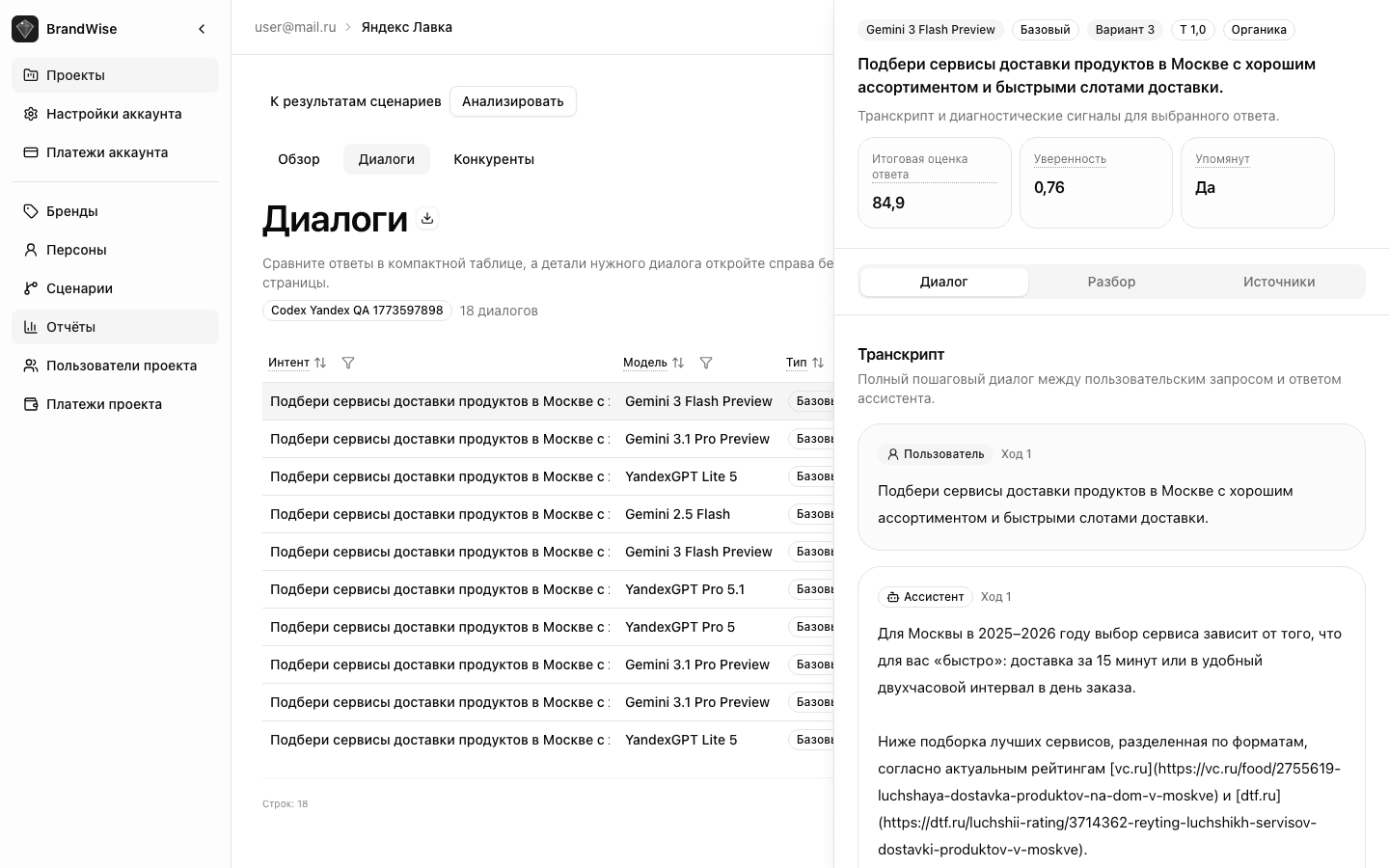
Brand TOM Competitive Table
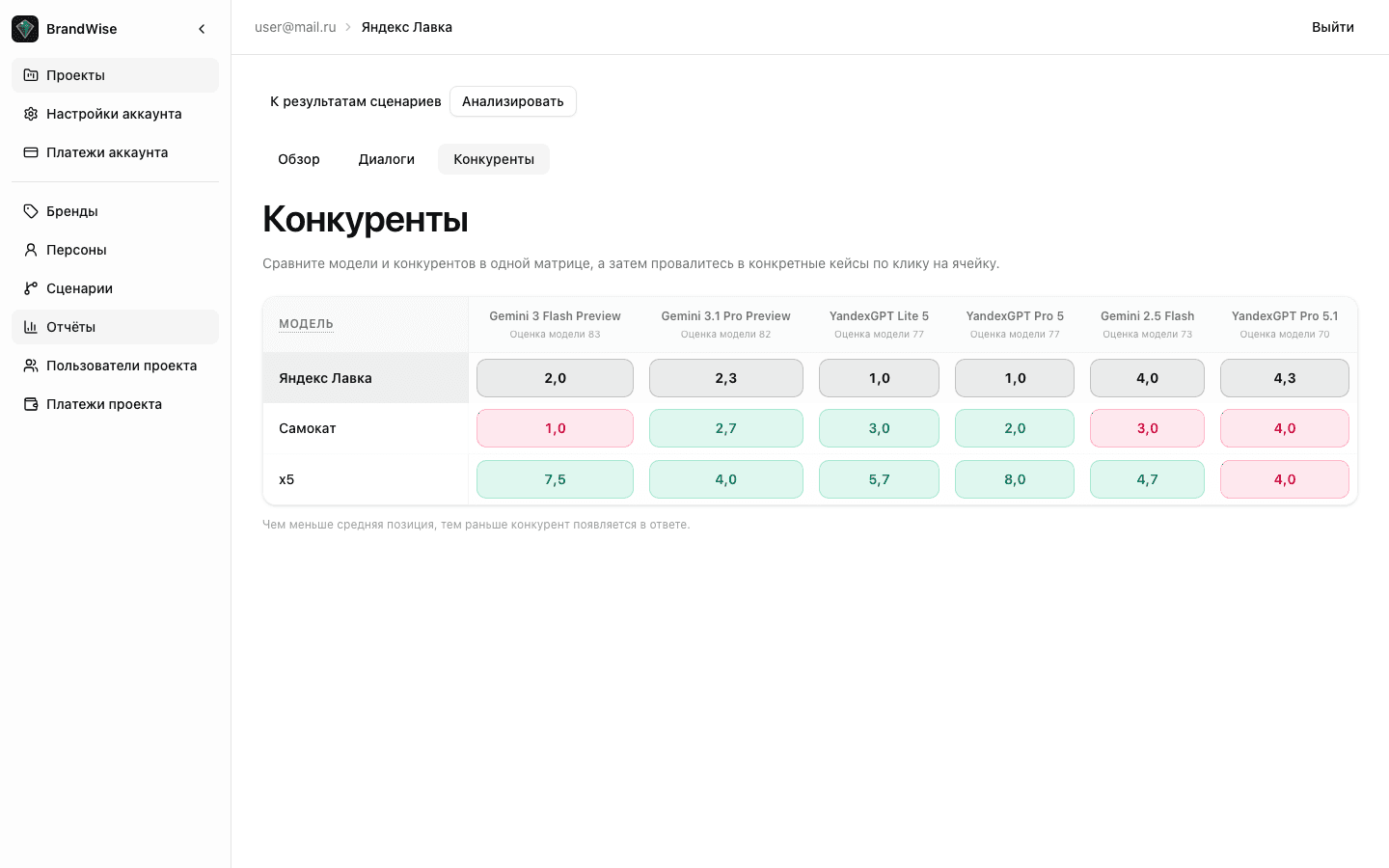
At the scenario level, BrandWise generates a summary table across all brands: target and competitors. For each brand, the following are calculated:
| Metric | Description |
|---|---|
| Mention Rate % | Share of responses where the brand is mentioned |
| Top-1 Rate % | Share of responses where the brand is mentioned first |
| Top-3 Rate % | Share of responses where the brand is in the top 3 |
| Avg Mention Order | Average position of first mention |
| TOM Score | Average Top of Mind score |
| vs Target Delta | Difference between competitor's and target brand's TOM |
This table is the primary competitive analysis tool in BrandWise. It shows not just the brand's absolute position, but the distance to each competitor.
Learn more about derived metrics in Derived and Aggregate Metrics.
Related Metrics
- Visibility — overall brand prominence
- Consideration — shortlist inclusion
- Metrics System Overview — all metrics and Overall Score
Usefulness — Does the AI Recommendation Help Users Take Action?
The Usefulness metric in BrandWise: measuring whether a brand mention in ChatGPT and Claude helps users make decisions. 5 components, formula, examples.
Consideration — Does Your Brand Make the AI Shortlist?
The Consideration metric in BrandWise: whether your brand makes the recommendation shortlist in ChatGPT, Claude, and Gemini. Formula, shortlist presence, comparative advantage, examples.